
WHAT'S SAF
Sustainable aviation fuel

Airplanes use jet fuel made from crude oil (fossil fuel).
SAF is an alternative to fossil-based jet fuel that
emits less carbon dioxide ( CO2 ), a greenhouse gas.
SAF is a new fuel and is currently under active technological development in various ways of making Here are six of them.
Here are six of them.
SAF is very accessible and can be made from raw materials that are closely related to our lives and work.
PRODUCTION
SAF Raw Materials

Waste oil, tallow, etc.
Waste edible oils, tallow, and other animal and vegetable oils and fats used as raw materials are pretreated to remove impurities, and then hydrogenated.
HEFA (Hydroprocessed Esters and Fatty Acids)


Inedible parts of sugarcane, corn, etc.
Alcohol is produced by fermentation of sugar obtained from the juice of sugarcane or cellulosic materials such as corn, grass, and trees through pretreatment and saccharification.
(Alternatively, alcohol can be obtained by fermentation using synthesis gas obtained by gasification as raw material.)
After dehydration and other processes are performed on the alcohol produced, SAF is produced through hydrogenation.
ATJ ( Alcohol to Jet)


Forest residues, etc.
When trees are harvested for logging, unused wood residues and thinned wood can be used as raw materials for cellulosic biomass. These are turned into SAF through gasification and rapid pyrolysis.
*Thinning: Thinning out dense timber during forest growth.
gasification

Rapid pyrolysis


Municipal waste, etc.
Synthesis gas obtained by gasifying municipal waste is used as raw material.
There are two ways to make SAF: FT synthesis oil made by a reaction called FT synthesis, and alcohol or products obtained by fermentation.
gasification


microalgae
Hydrogenation treatment of oils and fats obtained from microalgae to produce SAF.
Cultivation and extraction


Carbon dioxide ( CO2)
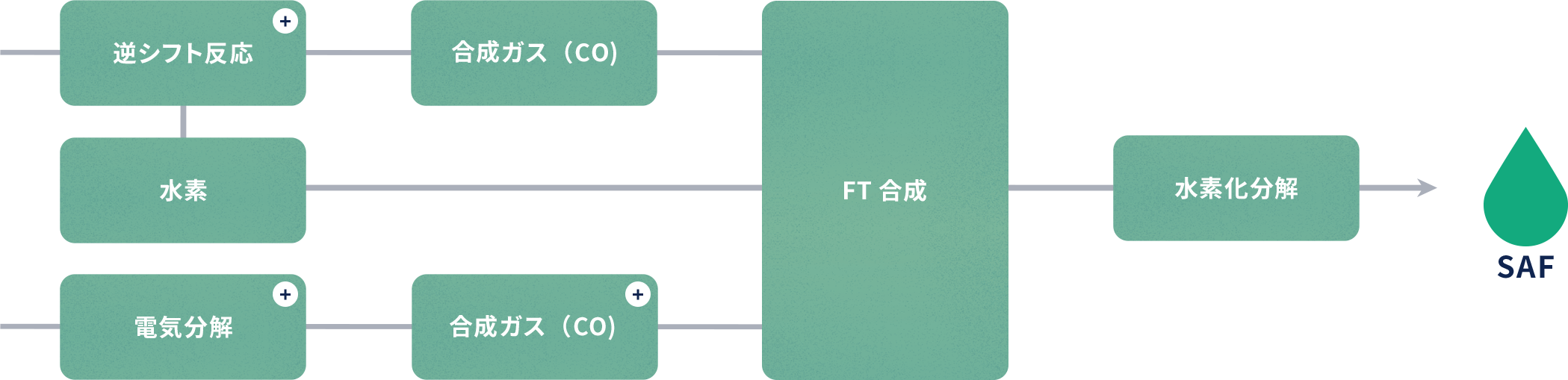
SAF is produced by FT synthesis of hydrogen and synthesis gas (CO) obtained from the reverse shift reaction of CO2 emitted from power plants and factories, etc. There is also a method to obtain synthesis gas (CO) by electrolysis of CO2.
Synthetic fuel (e-fuel)

hydrogenation
A petroleum refining process. A process in which raw materials and hydrogen react in a catalytic environment to produce liquid fuels and other products.
saccharification
A reaction in which sugar and protein combine.
gasification
The conversion of a liquid or solid into a gas.
syngas
Artificially synthesized gas.
FT Synthesis
A reaction that synthesizes liquid fuel from carbon monoxide and hydrogen using a catalytic reaction.
Rapid pyrolysis
Rapid heating of raw materials followed by rapid cooling of the resulting product.
biocrude oil
Crude oil produced from biologically derived resources (biomass).
hydrogenolysis
Decomposition of organic compounds in the presence of hydrogen.
FT Synthesis
A reaction that synthesizes liquid fuel from carbon monoxide and hydrogen using a catalytic reaction.
ATJ
Abbreviation for Alcohol To Jet. The process of making fuel from alcohol.
culture
Artificial increase of bacteria.
back-shift reaction
A reaction that produces carbon monoxide (CO) and water vapor ( H2O ) from carbon dioxide ( CO2) and hydrogen ( H2).
electrolysis
A method in which an electric current or voltage causes a reaction to yield a product.
syngas
Artificially synthesized gas.